

Think of a principle your organisation still holds that predates everyone now in the room. Then ask how it got there.
Most organisations cannot answer. The principle shows up in what gets funded, in what gets refused, and eventually in what a board is asked to defend, and nobody can say who paid for it, or when. It arrived. It stayed.
The question matters because the usual answer is wrong. The usual answer is that somebody wrote it down.
Two stories, separated by two thousand years, show what actually happens.
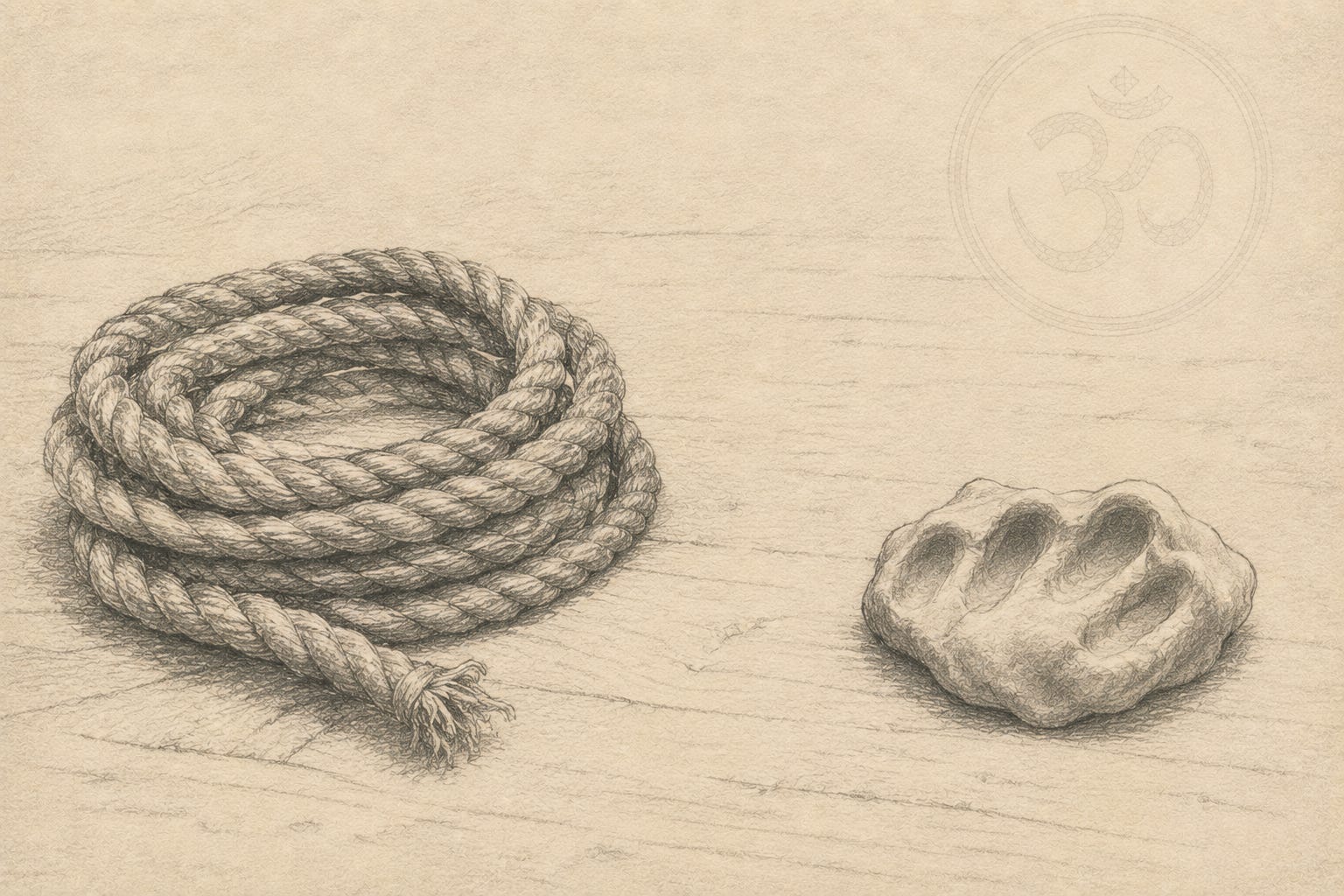
The rope that held
Ulysses is a Greek king sailing home after ten years of war. Before the next leg he is warned about a stretch of water ahead, where two creatures called the Sirens sing.
The warning is stranger than it first sounds. The Sirens do not attack. They do not need to. Any sailor who hears the song wants to go to them, and turns the ship toward the voice himself, and the ship breaks on the rocks. The meadow where they sit is heaped with the bones of men who did exactly that.
So the danger is not the rocks. The danger is that a man will want the rocks. He will steer for them with his own hands, and he will be certain at the time that he is right.
Ulysses wants to hear the song anyway. He also knows precisely what will happen to him. He will order the ship turned. He will mean it. He will be the captain, and they will be his orders, given in his own voice.
So he arranges matters in advance, while he can still think clearly.
He tells the crew to tie him to the mast, to ignore anything he says once he is bound, and to tie him tighter if he begs to be released.
That is the half everyone remembers.
Here is the other half. He takes a round of beeswax, softens it in his hands, and plugs the ears of every man at the oars, so that they hear nothing at all.
Then the ship passes the coast and it goes exactly as he predicted. He hears the song. He strains against the ropes. He shouts at his men to turn the ship. They cannot hear him, and they row on.
Ulysses heard the song and lived. The rowers crossed in silence. They never heard it, and they were never asked whether they wanted to.
The philosopher Jon Elster built an argument on the rope. In 1979 he named the idea. Precommitment. You do not rely on resisting at the moment of temptation, because at that moment your judgement is the thing that has failed. You remove the option beforehand, while you are still the person who can see the situation clearly.
Twenty-one years later he returned to the story and changed his mind about his own earlier work. He had argued that a constitution is a nation binding itself. A colleague told him that in politics people never bind themselves, only others. Elster accepted this was closer to the truth than what he had written, and pointed at the wax.
The rope that did not
Around 261 BCE the emperor Ashoka went to war against Kalinga, the territory covering most of what is now Odisha. He won. His own inscription records what it took. A hundred and fifty thousand deported. A hundred thousand killed. Many times that number dead in the aftermath.
Then something turned in him, and the edict is unusually specific about what.
It was not the campaign he regretted. It was the suffering, and particularly the suffering of people who had no part in the fighting. The edict names them. Households broken apart. Injury falling on the devout, the old, the ordinary. Friends and relations of the dead who were nowhere near the fighting. It says the killing weighed on him, and it says so in the first person, in public, on stone.
That remorse is the reason for everything that follows. He does not record it as a feeling he had. He records it as the cause of a decision.
He gave up war as an instrument of state. In its place he declared that the only conquest worth having was conquest by dhamma, by right conduct, and that this was the measure he now wanted applied to his reign.
For a ruler of that period this was not a gesture. Conquest was how territory grew, how treasuries filled, and how a throne stayed safe. He was giving up the main thing he had, and putting a slower and far less certain thing in its place.
Then he did the harder part. He tried to make the decision outlast him.
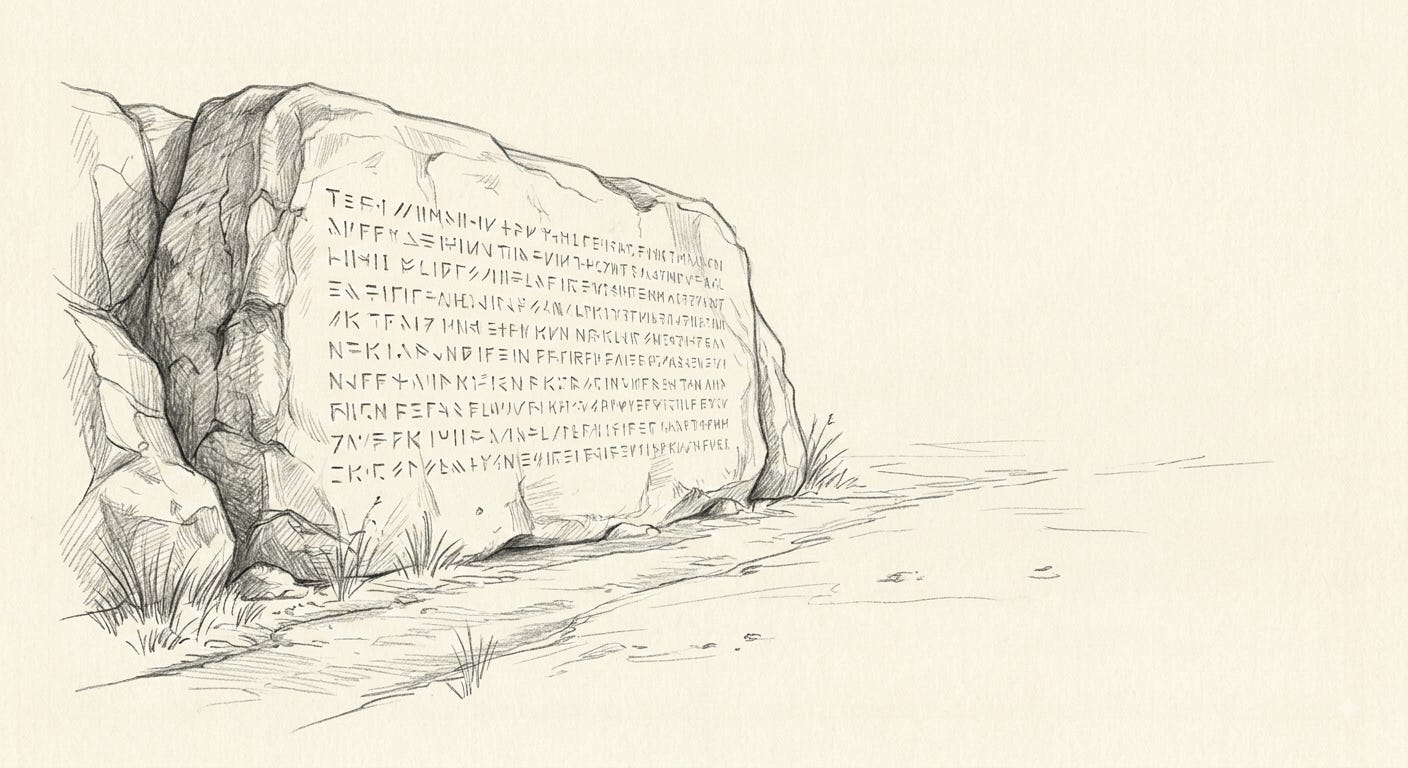
He had it carved into rock faces across the empire, and the inscription says why. He wrote it so that his sons and his great-grandsons would not think a new conquest ought to be made. He was not binding himself. He was already convinced. He was binding people he would never meet, in an office he would no longer hold.
That is a rope, and it is more ambitious than anything Ulysses attempted. Consider what he put behind it. Multiple sites across the empire. Local languages, so it could be read by the people it governed. The reasoning written out in full rather than the instruction alone. And the most durable medium available to any ruler on earth.
Three things happened to it.
The first is where the rocks stand. There is one at Dhauli, on the bank of the river Daya, a short distance from where the killing happened, and another at Jaugada further south. Both sit inside the conquered territory. Both carry his edicts. Neither carries that one. At both sites the sequence runs through the first ten edicts, skips three, and resumes, and the three that are missing include the account of the war and the remorse. He published his confession across an empire and left it off the two rocks standing nearest the people who had survived what he was confessing to. Historians disagree about why, and limited space on the rock is among the explanations offered. Whatever the reason, the people best placed to know what the war had cost, and therefore best placed to testify that his change of course was real, were the people not shown it.
The second is what happened to the dynasty. Ashoka died around 232 BCE. Roughly fifty years later the last Mauryan ruler was assassinated by his own army commander, and the empire he had tried to bind was gone.
The third is what happened to the words. The script itself fell out of use. The inscriptions stood in the open, in plain sight, on roads people walked past, and there came a point at which not a single living person could read them. They were deciphered by James Prinsep, an official of the Calcutta mint, who published his findings between 1836 and 1838.
An emperor wrote his deepest commitment into stone so that his descendants would be held to it. They were not. And for something close to two thousand years, no one who walked past the rock could tell what it said.
What the two stories leave
Ulysses tied the rope to himself and it held for exactly as long as he was inside it. Ashoka tied the rope to his heirs, in the most permanent form available, with the reasoning included, and it did not hold at all.
You cannot precommit an institution. You can only precommit yourself.
A constraint written for other people is not a rope. It is a rule. Rules are held by whoever holds the pen, and the pen changes hands.
Which leaves the question the two stories were really asking. If a written constraint does not transmit, how does anything an institution believes survive the person who believed it?
My answer, and I offer it as a view rather than as a finding, is that it survives through cost that other people watched someone pay.
The mechanism is not mysterious. A document requires somebody to open it, and then to care about what it says, and neither of those things happens reliably once the author has gone. A story requires neither. People tell each other about the time a leader gave something up, on a specific day, when giving it up was expensive and avoidable, because that is the kind of thing human beings find worth repeating. The principle travels inside the story. It lasts precisely as long as the story does.
This is why the rule you enforce on other people has a short life and the one that visibly caught you has a long one.
The obvious objection
Some constraints plainly do survive in writing. Law does. Regulation does. Contracts do. Whole industries operate under rules that outlived everyone who drafted them, and nobody had to watch anyone suffer for it.
That is true and it does not weaken the argument. It locates it.
Written constraints persist when something outside the institution enforces them. A regulator, a court, a counterparty with a claim. What makes them durable is the external consequence. The writing only records it.
Underneath that sits a narrower distinction, and it is the one that matters here.
Writing transmits knowledge extremely well. It does not transmit obligation at all.
Ashoka’s stone did its job perfectly. When the script was finally read, nothing had been lost. His reasoning survived intact for two thousand years, in his own words, and we can read today exactly why he stopped making war. What did not survive was the bindingness. His descendants could read it and not be held by it. So can we.
He had no external enforcer. Neither does the principle you are proposing to leave behind at the end of your tenure. For anything an institution holds voluntarily, and that is most of what makes an institution what it is, writing down the obligation is the weakest available form of transmission. Writing down what the obligation produces is a different matter entirely, and it works.
Ropes and wax in an estate
Every organisation has ropes.
The change freeze that holds through the quarter regardless of who escalates. The deployment that cannot ship until a rollback has been executed rather than written down. The permission model that denies by default and cannot be waived by the person under delivery pressure. The data boundary that needs a named accountable executive to cross, and a record of who crossed it.
Look at the second of those again, because it is the same distinction in engineering form. A documented rollback is knowledge. An executed rollback is obligation, discharged, by someone, at a cost in time on a date when nobody wanted to spend it.
These are good things. They are ropes tied on a calm day, for a day that will not be calm.
Every organisation also has wax.
There is a plain way to tell them apart. Take any rule your organisation is proud of and ask one question.
Whose day does this make harder?
If the answer is never the person who wrote it, you are looking at an instruction, and it will last about as long as the person enforcing it.
The rule I wrote that caught me first
I have written before about invisible work. This is a different question. When I set a rule, who did it catch?
In the teams I have led, I made it a requirement that key design decisions are written down, that solution intent is captured and taken through review, and that architecture records live somewhere people can find them and argue with them.
That sounds like governance. It did not feel like governance, because it reached me before it reached anyone else.
It took away the thing I most wanted under delivery pressure, which is to decide fast and explain later. It put my reasoning in writing, in front of people entitled to disagree with it, at the moments when I was least sure. It cost me hours I did not have, on dates that were already fixed.
The records themselves did transmit. That is what records are for, and a team inheriting them does not have to repeat the reasoning that produced them. But the requirement to keep making them was never going to survive the way the records did. That part travelled differently.
What made it hold was not the requirement. Requirements are easy to write and easy to suspend. It held because people watched it apply to me on a date when it was expensive, and when suspending it was entirely within my gift.
I thought I was setting a standard. I was paying for one.
What I ask before I write a rule now
One question. Which of my own decisions does this take away?
If the answer is none, I have not made a commitment. I have issued an instruction, and I should expect it to leave the building with whoever is enforcing it. That is not a small matter for an institution that will one day have to explain to a regulator, or to a customer, why a boundary it published was not the boundary it kept.
Ashoka chose stone. It was the most durable thing available to him, and it carried his reasoning across two thousand years without losing a word. It carried none of the obligation, because obligation has never once survived in a medium.
An institution never inherits a rule. It inherits the memory of what the rule cost the person who kept it.
If you found this useful, the likelihood is someone you know is asking the same question. Pass it on.