

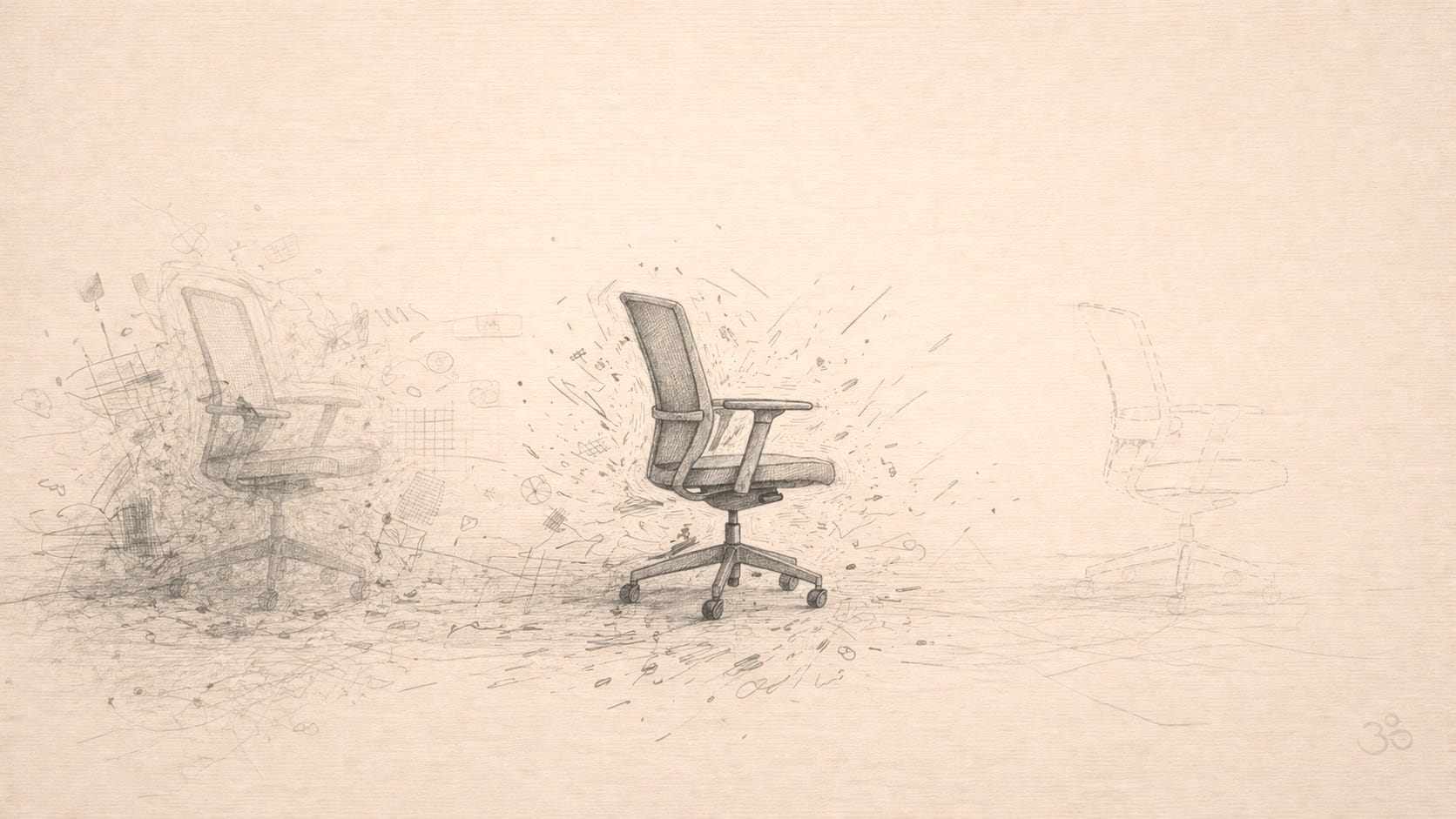
Every decision your predecessors made is currently in the system you govern.
Every decision you make now will be in the system your successor inherits.
The question is whether you are leading for your tenure or for the full arc of decisions that shape the landscape.
Most technology leadership writing addresses only the present. The decisions being made now. The work being delivered now. The systems being run now. This framing is incomplete. Every system a leader operates inside was shaped by predecessors whose names may not be known and whose reasoning may not be documented. Every system a leader shapes during their tenure will be operated by successors whose judgments on current decisions will be made without the context that informs those decisions today.
The true measure of technology leadership is what is inherited on both sides of the current seat. Not what is visible during the tenure. What is inherited from the tenure. And what was inherited into it.
What Leaders Actually Inherit.
The inheritance is rarely itemised. But it is always specific.
Compounding liability accumulated under delivery pressure years ago, now manifesting as the delivery delay the current leader is absorbing quarter after quarter. Uncontained failure modes that have been surfacing across the landscape without being recognised as the same pattern. Capital commitments embedded in architectural choices made for reasons no longer documented. Boundary gaps where accountability was negotiated rather than designed.
The inheritance also includes what was done well. The bounded contexts that were correctly drawn years ago that still serve the landscape. The containment design that was funded before an incident made it urgent. The observability infrastructure that was built at the right level rather than only at the engineering level. These are the quiet assets inherited alongside the liabilities.
Every leader inheriting a seat is receiving both. Neither is immediately visible. The liabilities only surface when something goes wrong. The assets only become visible when the leader tries to do something the landscape supports because of them.
What I Inherited.
The first time I walked into a senior technology seat with significant inherited landscape, I did what most leaders do. I asked for the system diagrams. I asked for the architecture documentation. I asked for the strategy. I read everything I was given. None of it told me what I actually needed to know.
What I needed to know was what the landscape was carrying. Not what it was supposed to be doing. What it was actually holding. The coupling that nobody could explain. The fragility that was being managed silently by people who had been there long enough to know which integrations to handle carefully. The trade-offs that had been made under pressure years earlier and were still shaping every release.
The diagrams did not show this. The architecture documentation did not show this. The strategy assumed it did not exist.
What showed it was conversations. Sitting with engineers and architects who had been there for years. Listening to what they said about the system without asking them to characterise it. Watching where they moved carefully and where they did not. The landscape was being communicated by the people who had been tending it. The communication was not in the documents. It was in the texture of how the work was being done.
I spent the first six months listening rather than changing. The expectation in any new senior seat is to demonstrate value through visible change in the first quarter. I made that choice differently because the landscape had not yet revealed itself, and decisions made before the landscape reveals itself are usually the ones that have to be remade later.
What I learned in those six months stayed with me. The landscape I had inherited was carrying decisions made by leaders I would never meet. Some of those decisions had served the landscape well. Some had not. Most had been made for reasons that were rational at the time and were no longer relevant. Almost none had been documented in a form that explained the reasoning rather than the outcome.
That is the most common condition of an inherited technology landscape. Not absence of documentation. Absence of reasoning.
The Balance.
The most consequential decision in any tenure is rarely about what to do next. It is about how to hold short-term and long-term simultaneously.
The pressure on a technology leader is almost entirely short-term. Quarterly outcomes. Visible delivery. Immediate stakeholder satisfaction. The recognition system rewards short-term wins. Long-term landscape health does not produce visible value during the tenure that funds it.
The default response is to optimise for what is rewarded. Loads of short-term fixes. Sticky plasters that keep things moving. Each fix individually defensible. Cumulatively, a landscape that has been patched rather than tended.
This is the most common failure of technology stewardship. Not bad decisions. Not insufficient capability. The wrong balance.
A stagnant landscape rots quickly. An evolving landscape delivers long-term value. The choice is not between change and stability. It is between the right kind of change and the wrong kind.
The right kind. Short-term action that keeps things moving while serving the long-term direction. Each fix evaluated not only for its immediate effect but for whether it leaves the landscape healthier or weaker. Long-term investment that does not produce visible value during the current tenure but accumulates value across tenures.
The wrong kind. Short-term action that solves the immediate problem at the cost of long-term integrity. Long-term investment that has lost contact with the operational reality and is no longer serving the people inside the landscape.
Holding the balance is the work. Not choosing one. Holding both. Making short-term moves that serve the long-term direction. Making long-term investments that respect the short-term reality. The leader who only delivers short-term claims victory at the cost of the landscape. The leader who only invests long-term loses the organisation’s confidence and the political capital required to continue.
Most leaders default to short-term. Genuine stewardship requires sustained attention to both at once.
What I Will Leave.
Every decision being made during the current tenure is constructing what the next leader will receive. The architectural choices. The capital commitments. The institutional memory system. Whether the containment design is funded. Whether the compounding liability register is held visibly. Whether the postmortem process produces funded design responses.
The harder question is not what the successor will think of these decisions. They will not be there to think in abstraction. They will be there to operate the consequences. The harder question is what condition the landscape will be in when they arrive.
I do not know the name of the leader who will inherit the current landscape. I know they will judge what I am doing now without the context that informs it today. I know the work I am doing now is being done for two audiences. The current tenure’s stakeholders. And the successor who will live inside the consequences of what is being built.
The balance between these two audiences is the same balance that runs through the work itself. Honour the current tenure’s reality. Honour the future tenure’s inheritance. Hold both at once.
Most leaders address only the first audience. The second audience determines whether the tenure accumulates value or transfers liability.
Compounding Stewardship and Compounding Liability.
Every technology landscape is compounding in one direction or the other.
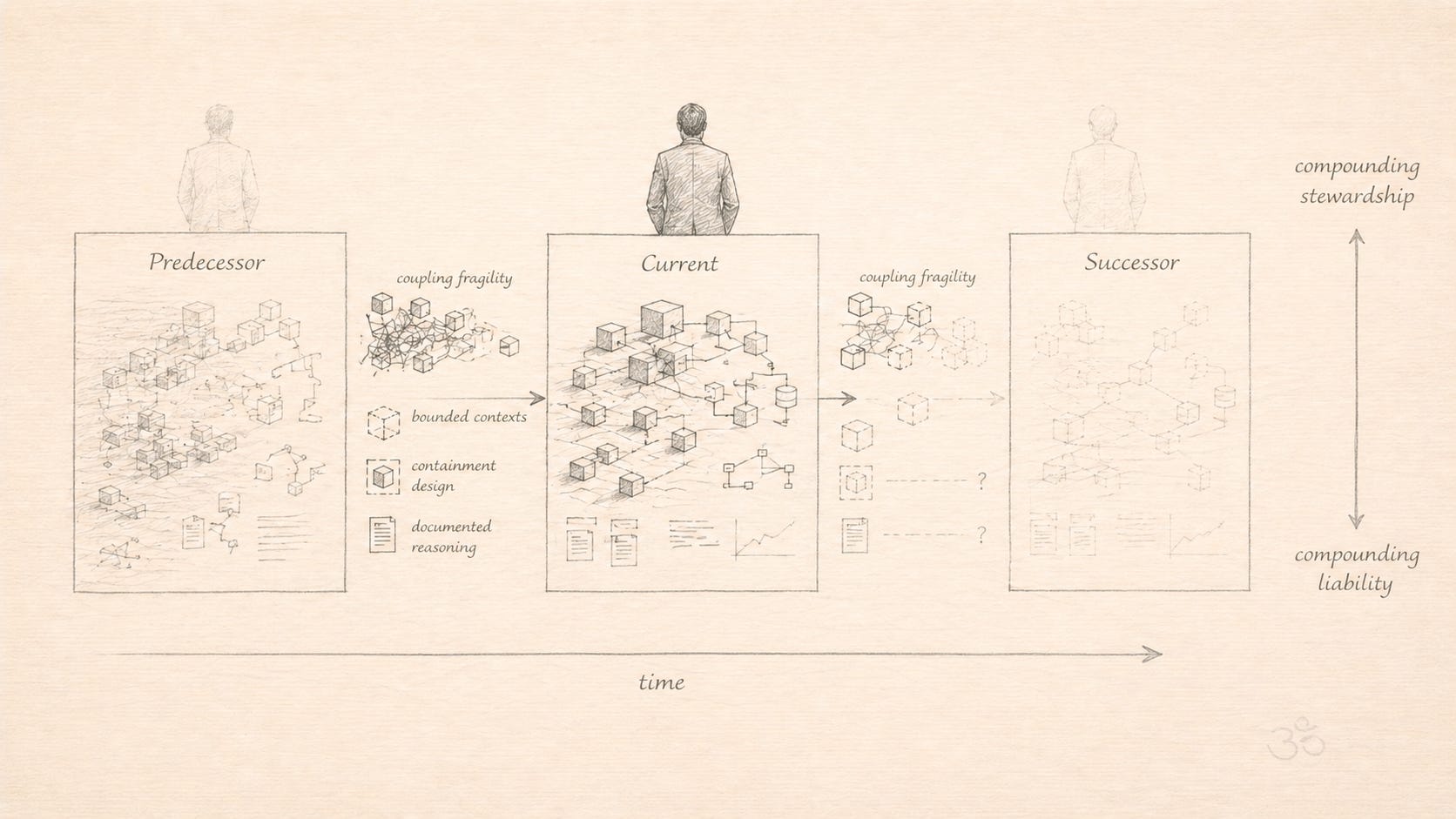
A landscape that has been receiving sustained stewardship across multiple tenures is compounding. The bounded contexts get clearer over time. The containment design gets stronger with each incident that surfaces a new failure mode. The institutional memory deepens. The reasoning behind decisions accumulates rather than disappearing with each leadership transition. The leader who inherits this landscape arrives with capacity. They can move strategically because the landscape supports it.
A landscape that has been receiving sticky plasters across multiple tenures is also compounding. In the opposite direction. The coupling thickens. The fragility accumulates. The undocumented decisions multiply. The reasoning behind earlier choices is lost with each transition. The leader who inherits this landscape arrives with consumption. Their first years are spent absorbing the deferred remediation that previous tenures did not fund.
The compounding direction is the leadership inheritance more consequential than any single decision the leader will make during their tenure.
Most evaluation frameworks measure tenure performance only. Outcomes delivered within the seat. Decisions made during the seat. The compounding direction across tenures is the truer measure. It is also the more difficult to capture, because it requires looking at the seat from outside the tenure that currently holds it.
This is the gap in how technology leadership is evaluated at board, investor, and executive level. The tenure is measured. The compounding direction is not. The full commercial truth of a technology leader’s work is not captured without both.
What Stewardship Actually Requires of You.
The practices of stewardship are not difficult to describe. They are difficult to do. The reason has nothing to do with capability and everything to do with disposition.
I have learned this over multiple tenures and I am still learning it.
Stewardship requires humility about what was inherited. Some of what I inherited was the work of leaders better than I was. The bounded contexts that were correctly drawn. The integrations that have held up under conditions nobody anticipated. The constraints that turned out to be wisdom in disguise. Recognising what predecessors did right requires me to set aside the instinct that anything I did not build is somehow inferior. That instinct is hard to set aside. It is also wrong.
Stewardship requires honesty about what no longer works. Some of what I inherited was rational at the time and is no longer serving the landscape. Acknowledging this is not a criticism of the predecessors who created it. It is a description of how landscapes evolve. What was right then can be wrong now without anyone having failed. Saying this in the organisation requires care. People who are still inside the landscape may have been part of those original decisions. Treating their work with respect while honestly naming what no longer serves is one of the harder disciplines of the seat.
Stewardship requires courage to surface what is uncomfortable. The compounding liabilities I have inherited are uncomfortable to surface because surfacing them implies criticism of the people who let them accumulate. The investments I propose for long-term landscape health are uncomfortable to surface because they will not produce visible value during the tenure that funds them. The decisions I am consciously deferring to my successor are uncomfortable to surface because they expose what I am choosing not to do.
Stewardship requires empathy for the people inside the landscape. The architects and engineers who have been tending the systems for years know more about what is actually happening than any leader walking in. They have been managing the inherited reality without the authority to change it. Treating them as colleagues whose knowledge is essential to the stewardship reframes the work. The landscape cannot be tended without them.
Stewardship requires leadership that takes people on the journey. Sustainable change requires the consent and participation of the people who will live inside the changed landscape. Imposing change from above produces resistance even when the change is correct. Taking people on the journey requires explaining the inheritance, naming the balance, surfacing the trade-offs, and inviting people to shape the response. It is slower. It is also the only kind of change that holds.
These are not techniques. They are dispositions. They show up in how a leader actually conducts the work day to day.
Four Stewardship Practices.
The disposition becomes visible through specific practices.
Walk the landscape before changing it.
The first six to twelve months in a senior seat are spent understanding what was inherited before any significant change is initiated. Sitting with the people who have been tending the systems. Listening to what the landscape is signalling. Forming an honest map before deciding what to do with it. The instinct to demonstrate value through visible change in the first quarter is the instinct that prevents this practice. Setting it aside is the first stewardship discipline.
Document the reasoning while it is still present.
The decisions made during the tenure are documented as reasoning, not only as outcomes. The constraints that were present. The trade-offs considered. The pressures that were active. The alternatives rejected and why. A successor inheriting documented reasoning can evaluate decisions in their original context. A successor inheriting only outcomes is forced to either accept them blindly or rebuild from scratch.
Hold the short-term and long-term simultaneously.
Each tenure makes investments in the landscape’s long-term health alongside the short-term delivery the organisation expects. The ratio is consciously chosen rather than defaulted to. Short-term wins are evaluated for whether they leave the landscape healthier or weaker. Long-term investments are evaluated for whether they remain connected to operational reality. The balance is the work.
Name what you are leaving without apology or evasion.
The exit from the seat, planned or otherwise, includes an explicit handover of what is being left. What was inherited. What was remediated. What was deferred and why. What patterns the next leader should be alert to. A handover that names what is being left clearly transfers value. A handover that obscures or deflects transfers ambiguity.
These four practices form a temporal arc across a tenure. Beginning, by walking the landscape. Across, by documenting the reasoning and holding the balance. End, by naming what is being left.
The Leadership Directive.
The seat is never held alone. It is held between the leader who left it and the leader who will inherit it. Across that span, the landscape either evolves or it rots. There is no third condition.
Every leader currently in a senior technology seat is making this choice now.
The choice is not whether to lead. It is whether to lead for the tenure or for the landscape.
The Sutra.
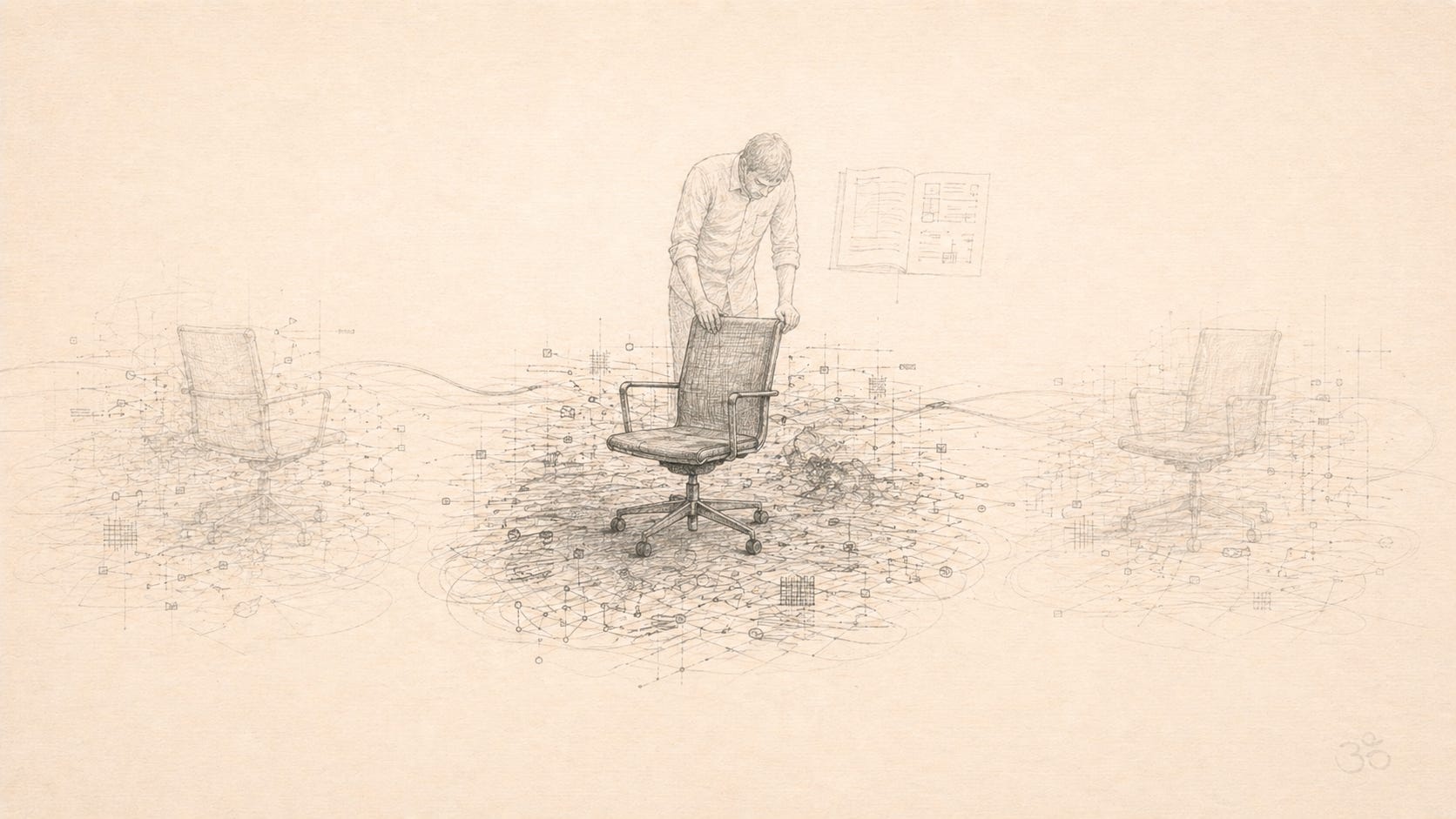
Inherit honestly. Tend deliberately. Leave better than you received. The seat carries no other measure that lasts.
If you found this useful, the likelihood is someone you know is asking the same question. Pass it on.