

Element Beyond the Elements — Time, Judgement, and the Cost of Deciding Too Early
“Most architectural mistakes are not wrong decisions.
They are decisions made too early.”

The Hidden Dimension of Architecture
Architecture is often described as structure, patterns, and design.
But there is a quieter dimension that shapes everything long before diagrams do.
Time.
Time determines which decisions can wait and which cannot.
Time decides when flexibility hardens into constraint.
Time converts convenience into architecture.
Good architecture is not about making the right choice in isolation.
It is about making the right choice at the right moment, with incomplete information, while preserving the future as much as possible.
This is the discipline most architectures fail at.
When a Decision Is Made Too Early
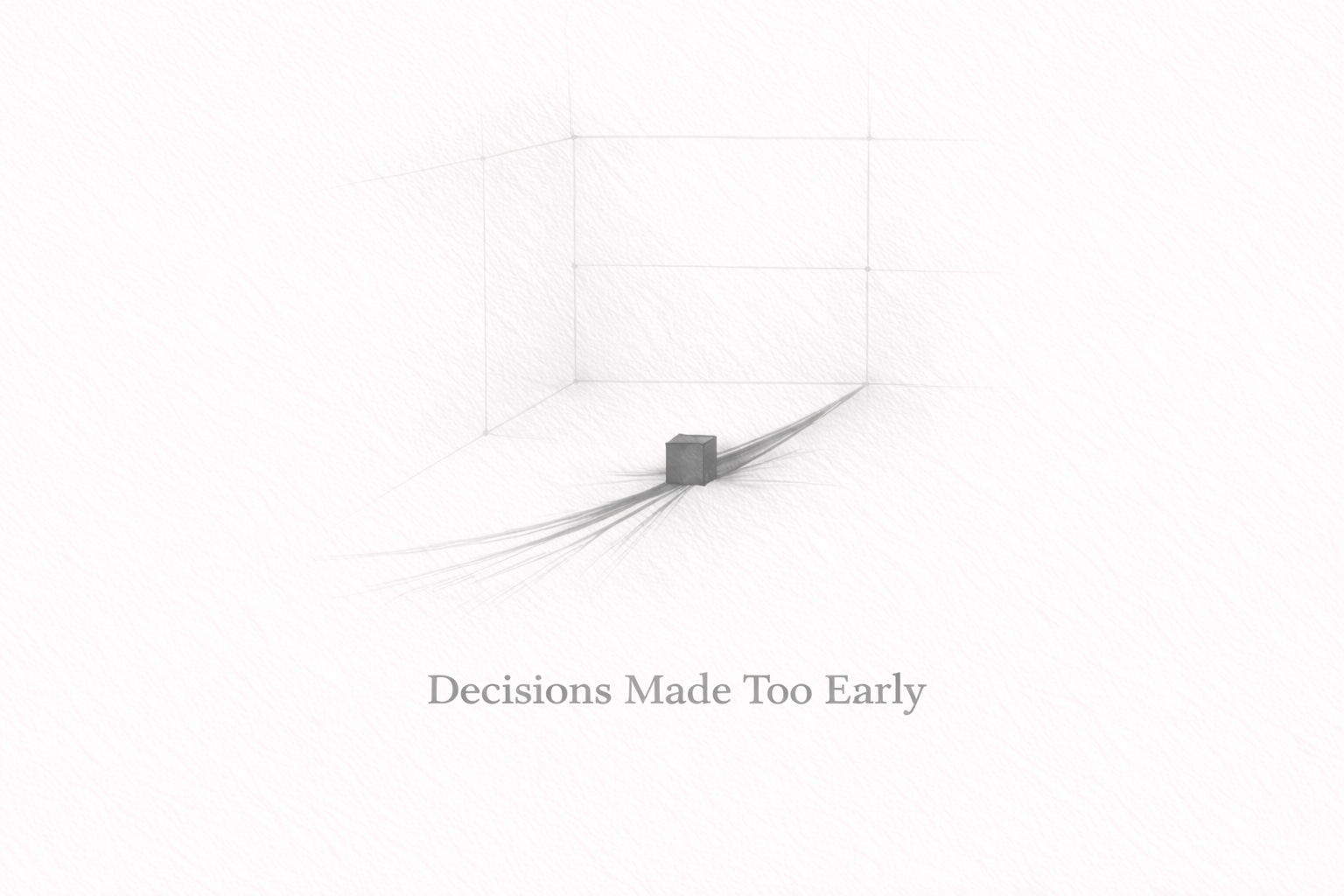
In a major partner integration, we moved fast.
There was pressure to deliver.
Little space for discovery.
And an unspoken assumption that we could refine the design later.
The integration was forced to be synchronous.
At the time, it felt reasonable.
It worked.
It met the immediate requirement.
But the decision was made too early.
Customer journeys became coupled to partner availability.
Latency leaked directly into experience.
Failures cascaded rather than being absorbed.
What mattered most was not that synchronous integration was chosen.
It was that it was chosen before we understood the problem deeply enough.
We did not choose the wrong architecture.
We chose it at the wrong time.
Once customers, SLAs, and downstream systems depended on it, the cost of reversal became enormous.
A decision that felt reversible in the moment quietly became permanent.
When a Decision Is Delayed Too Long
In another programme, a different problem emerged.
There was an unresolved question about ownership.
Should certain business rules live in the front end or the core domain?
The discussion lingered.
Delivery pressure mounted.
No one wanted to block progress.
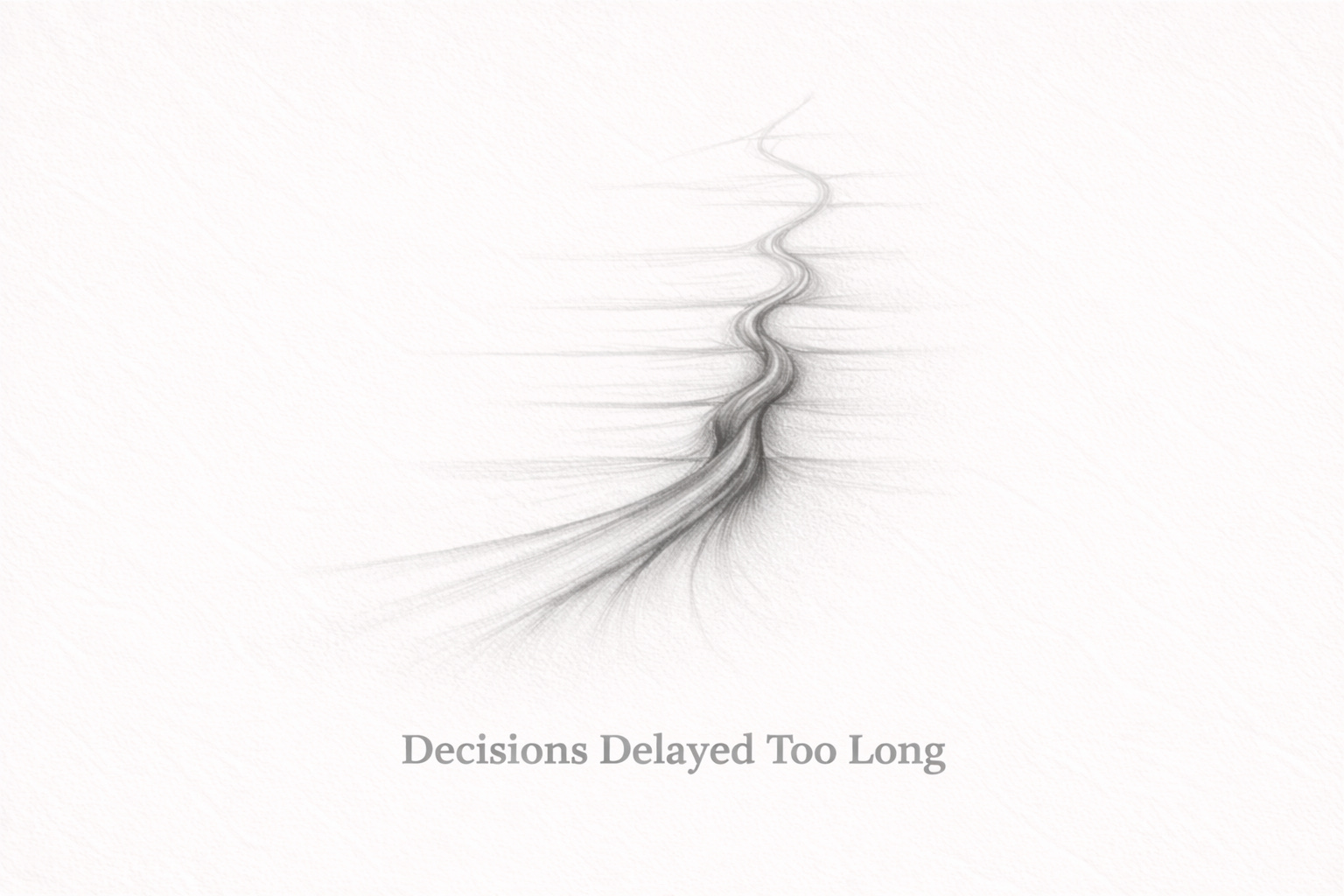
So the system made the decision for us.
Logic flowed to the front end.
At first, it looked like speed.
Teams moved quickly.
Features shipped.
But time changed the nature of the choice.
Logic duplicated across channels.
Inconsistencies crept in.
Simple changes required coordination across multiple teams.
Time to market slowed.
What started as a temporary convenience became a structural constraint.
The mistake was not the initial compromise.
It was letting time pass without intent.
Delay without direction is still a decision.
And time has a way of making those decisions irreversible.
When Timing and Readiness Do Not Align
In a large scale programme, we introduced a new platform with multiple domains.
The aspiration was clear.
Clean abstraction.
Loose coupling.
A clear boundary between old and new.
But the existing systems were tightly coupled to their data models.
Teams had different priorities.
Capacity to evolve was limited.
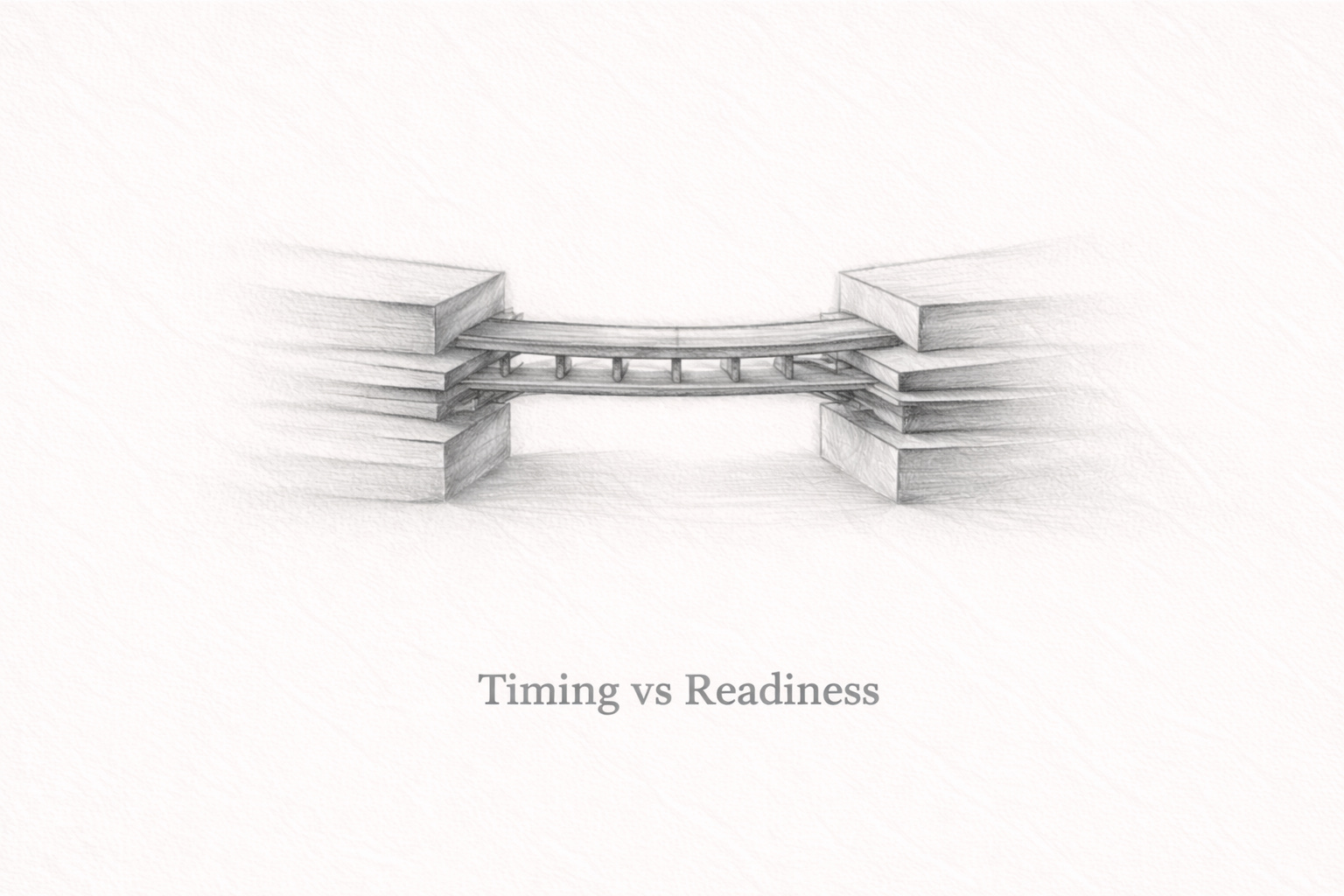
The organisation was not ready for the abstraction the architecture demanded.
So the decision shifted.
Instead of reshaping boundaries, layers of translation were added.
Some were brittle.
Some were flawed.
All increased complexity.
This was not a bad decision.
It was a constrained one.
Architecture is not only shaped by technical truth.
It is shaped by organisational readiness in time.
When timing and capability are misaligned, architecture bends to reality.
The Architecture of Time
Across all three stories, the pattern is consistent.
Decisions made too early lock in constraints
Decisions delayed too long harden into structure
Decisions made without regard to readiness accumulate complexity
Time is not neutral in architecture.
It magnifies decisions.
Some choices are cheap to reverse.
Others are expensive.
Some close doors forever.
The role of an architect is not to decide everything upfront.
It is to know which decisions to delay, which to sequence, and which to protect until the last responsible moment.
This is judgement.
Leadership and the Stewardship of Time
Architects are often asked for answers.
Leaders should instead ask them for judgement.
Judgement about timing.
Judgement about reversibility.
Judgement about what must be decided now and what must remain open.
Pressure collapses time.
Wisdom expands it.
The best architects do not rush decisions.
They protect option value.
They explain delay as discipline, not indecision.
They understand that every early commitment is a bet against the future.

⏳ Summary: What Time Teaches Us
Architecture is shaped by when decisions are made, not just what is decided
Reversibility shrinks over time
Delay without intent is still a decision
Organisational readiness matters as much as technical correctness
Good architecture preserves options for as long as possible
⏳ The Time Sutra
Architecture is the discipline of deciding what not to decide yet.

Reflection
Which architectural decisions in your system were made before you truly understood the problem?
Which compromises felt temporary but became permanent through time?
And which decisions are you making today that future teams will be forced to live with?
These are not design questions.
They are questions of judgement.