


Every delivery delay, every scaling constraint, every incident, every regulatory response that went too slowly had a predecessor that recorded the same signal in the system.
The question is whether your governance was designed to read it. Or whether each new surface had to translate it again.
Every architectural choice is present in the integration. Every coupling introduced under delivery pressure is embedded in the code. Every trade-off deferred during a programme that has since closed is carried forward in the behaviour of the system under load. The system does not forget. It cannot forget. Every decision is structural.
The gap is not what the system remembers. The gap is what the organisation has been designed to hold from what the system has recorded.
The Term Is Misdirecting the Governance Response.
The term most organisations use for what accumulates in a system over time is technical debt. It is imprecise in the way that matters most.
The word technical places the liability in the architects and engineers. It implies the debt was created by the people deferring work they should have done. This is rarely the accurate account. The debt was more often created by decisions made above the technology team. Delivery pressure. Underfunded timelines. Prioritisation calls that treated architectural investment as secondary to feature delivery. The architects and engineers were the executors of these decisions. Not the authors of them.
The word debt implies deferred work rather than accumulated consequence. It produces a governance response that treats the accumulation as a backlog of things to be cleaned up when there is time. Backlogs are engineering artefacts. They compete with feature delivery. They almost always lose.
Both elements of the term misdirect the governance response. The architects and engineers are held accountable for a liability they did not create. The backlog framing produces competition it cannot win. The liability grows.
What It Actually Is.
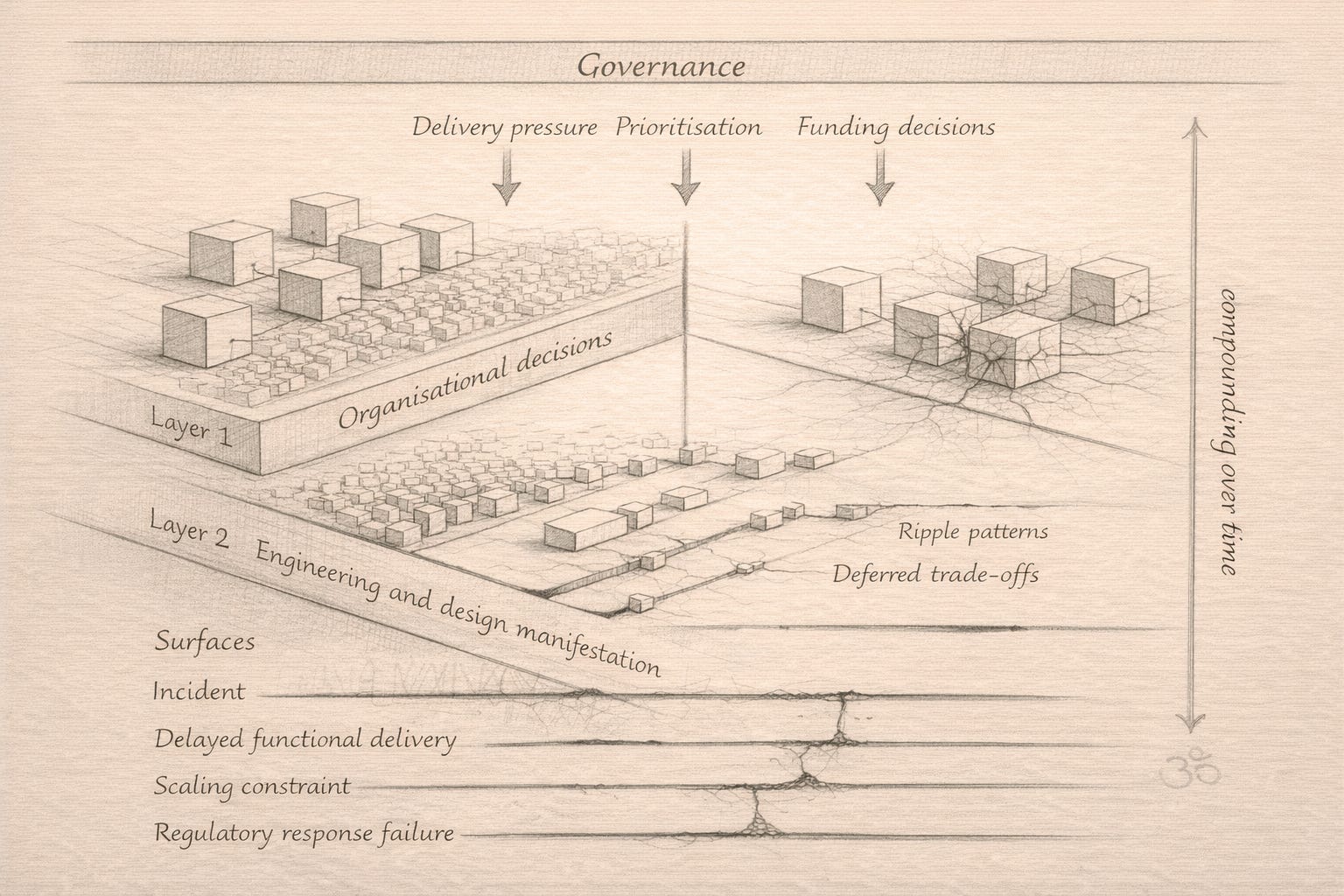
The more precise term is compounding organisational liability. It has three layers.
Layer 1. Organisational decisions.
The decisions made across the business and technology boundary under delivery pressure, misaligned incentives, and underfunded timelines. These are the decisions that created the conditions within which the architects and engineers did their work. The liability is organisational in origin and ownership.
Layer 2. Architecture & Engineering manifestation.
The physical expression of the Layer 1 decisions in the system. Coupling that was not resolved. Fragility that accumulated incrementally. Trade-offs made under pressure and never revisited. This is where the liability becomes visible. But it did not originate here.
Layer 3. The surfaces where the liability manifests.
The compounding liability does not only surface as incidents. It surfaces as a constraint on the organisation’s ability to act. Four manifestations appear consistently.
The incident. The catastrophic surface. The principal arriving after years of interest payments.
The delayed functional delivery. The organisation wants to launch a new product, capability, or feature. The existing architecture cannot absorb it. What should have been a three-month delivery becomes a twelve-month remediation programme. The competitive window closes.
The non-functional scaling constraint. The system cannot carry increased load, new geographic regions, or new volumetric demands. The organisation can sell the capability but cannot deliver it at scale.
The regulatory or market response failure. Regulations evolve. Markets shift. The organisation needs to change something structural to respond. The existing architecture makes the change economically or technically infeasible within the required timeline. The organisation absorbs penalties or loses commercial position because the compounding liability has removed its optionality.
All four are the same liability manifesting differently. The incident is the most dramatic surface. For most organisations most of the time, the other three are the more common and more commercially consequential.
Between Layer 1 and Layer 3, the liability compounds. Each delivery cycle that defers the governance response adds to the accumulation. The interest is paid in engineering effort absorbed, in workarounds maintained, in institutional fragility carried forward. The principal arrives when the cumulative weight breaks through to one of the Layer 3 surfaces.
This distinction determines who is accountable for governing it. Compounding organisational liability is not an engineering backlog item. It is an organisational exposure that requires governance at the same level as the decisions that created it.
What the Liability Looks Like From the Inside.
Across programmes I have been directly involved in, a specific pattern appears in postmortems. A previous postmortem had identified the same failure mode. The design response was recommended. The funding was not committed. The next incident is not a surprise from the system’s perspective. The system had been signalling the same compounding liability since the first incident. The organisation’s institutional memory had recorded the signal. The governance system had not acted on it.
In one programme I was directly involved in, this was the moment that changed how I think about governance of technology liabilities. The cascade that produced the incident had two roots at the Layer 2 manifestation level. Coupling that had been introduced under delivery pressure eighteen months earlier and never decoupled. And accumulated data model changes that had made a downstream integration fragile in ways that no single change review would have caught. Both were engineering and design manifestations of organisational decisions made under delivery pressure. The postmortem that followed identified both. Then the team found the previous postmortem. The same coupling had been identified eighteen months earlier. The design response had been recommended. The funding had not been committed. The system had remembered. The organisation had not been designed to hold the memory long enough to act on it.
The same liability had been manifesting at the other Layer 3 surfaces for months before the incident. A functional capability launch had been delayed. A scaling initiative had been quietly scoped down. These were not recognised as the same pattern. They were treated as separate delivery problems. The incident was the moment the pattern became undeniable.
Had the liability been framed correctly from the first postmortem, the design response would have been on the governance agenda as a funded capital exposure rather than as an engineering backlog item. The coupling would have been decoupled. The cascade would not have occurred. The functional launch would have been on time. The scaling initiative would not have been scoped down.
The failure was not that the organisation did not know. The failure was that the knowledge was held in a form the governance system was not designed to read, because the term that should have framed it as a governance exposure had instead framed it as an engineering problem.
The Governance Gap.
Most organisations have not addressed compounding organisational liability for three reasons. Each is a governance design failure that the misframing produces.
The first. The liability register is held as an engineering backlog rather than as a capital exposure. The items on it are described in engineering terms. They are prioritised against engineering work. They never reach the governance level where the decisions that created them were made. The liability accumulates unseen by the only people with the authority to fund the response.
The second. The postmortem is treated as a cultural exercise rather than a governance event. The blameless conversation produces a document. The document produces action items. The action items enter the backlog. The urgency dissipates within days of the incident closing. The knowledge the system generated is not made durable. The measure of a postmortem’s integrity is not whether the conversation was blameless. It is whether the conversation produced a funded design response within a defined governance timeline. Most do not.
The third. The observability design is held at the technology team level rather than the governance level. The Layer 2 manifestations are visible to the architects and engineers through logs, metrics, and traces. They are not visible to governance through a framing that connects them to the Layer 1 decisions that created them or the Layer 3 surfaces they are compounding toward. Governance is operating against a partial view of the liability it is accountable for.
All three failures are produced by the same misframing. The liability is treated as technical when it is organisational. It is treated as debt when it is compounding exposure. The governance response is calibrated to the wrong problem.
What Governance Must Do.
The constructive move. Three disciplines that make compounding organisational liability governable. Each addresses one of the three gaps above.
Reframe the register as a capital exposure.
The register of compounding organisational liability is a governance instrument. Its items are capital exposures expressed in terms the board can price. Each item carries three dimensions. The Layer 1 organisational decision that created it. The Layer 2 manifestation currently visible in the system. The projected Layer 3 surface profile if the liability is not funded, covering potential incident exposure, delivery constraint, scaling constraint, and regulatory response constraint. The register is reviewed at governance cadence alongside other capital exposures.
Measure postmortem integrity by funded design response.
The postmortem is a governance event, not a cultural one. Its measure is what percentage of postmortems in the last twelve months produced a funded design change within a defined timeline. If the number is close to zero, the organisation is generating knowledge that the governance system is not acting on. The blameless cultural achievement is preserved. The governance accountability for what the conversation produces is added.
Design observability at governance level.
The observability design should be reviewed at the same governance level as the system design. Its purpose is not engineering telemetry. It is governance visibility. Can the organisation measure what matters to customers and regulators in real time. Can it measure the compounding liability accumulating at Layer 2 before it surfaces at Layer 3. If not, governance is accountable for a system it cannot see.
Together these three disciplines make the full three-layer framework governable. The register holds the liability. The postmortem translates surfaces into design responses that reduce it. The observability makes the accumulation visible before any of the Layer 3 surfaces makes it visible catastrophically.
An estate evaluated against these three disciplines is a fundamentally different asset from one evaluated only on its current systems.
The Leadership Decision.
The misframing of compounding organisational liability as technical debt is not an engineering mistake. It is a governance one.
The organisation that accepts the technical debt framing has accepted that its most consequential accumulating liability will be held as an engineering backlog. The organisation that accepts the register at the engineering level has accepted that the liability will not be priced at the level where the decisions that created it were made. The organisation that accepts postmortems as cultural exercises has accepted that the knowledge its systems generate will not be made durable.
All three are leadership decisions dressed as engineering practices.
The system remembers every decision. The question is whether the governance system has been designed to hold what the system has recorded, price what it has held, and fund the response before the next surface, whether that is an incident, a delayed launch, a scaling constraint, or a regulatory response failure, makes the cost of not funding it unavoidable.
The Sutra
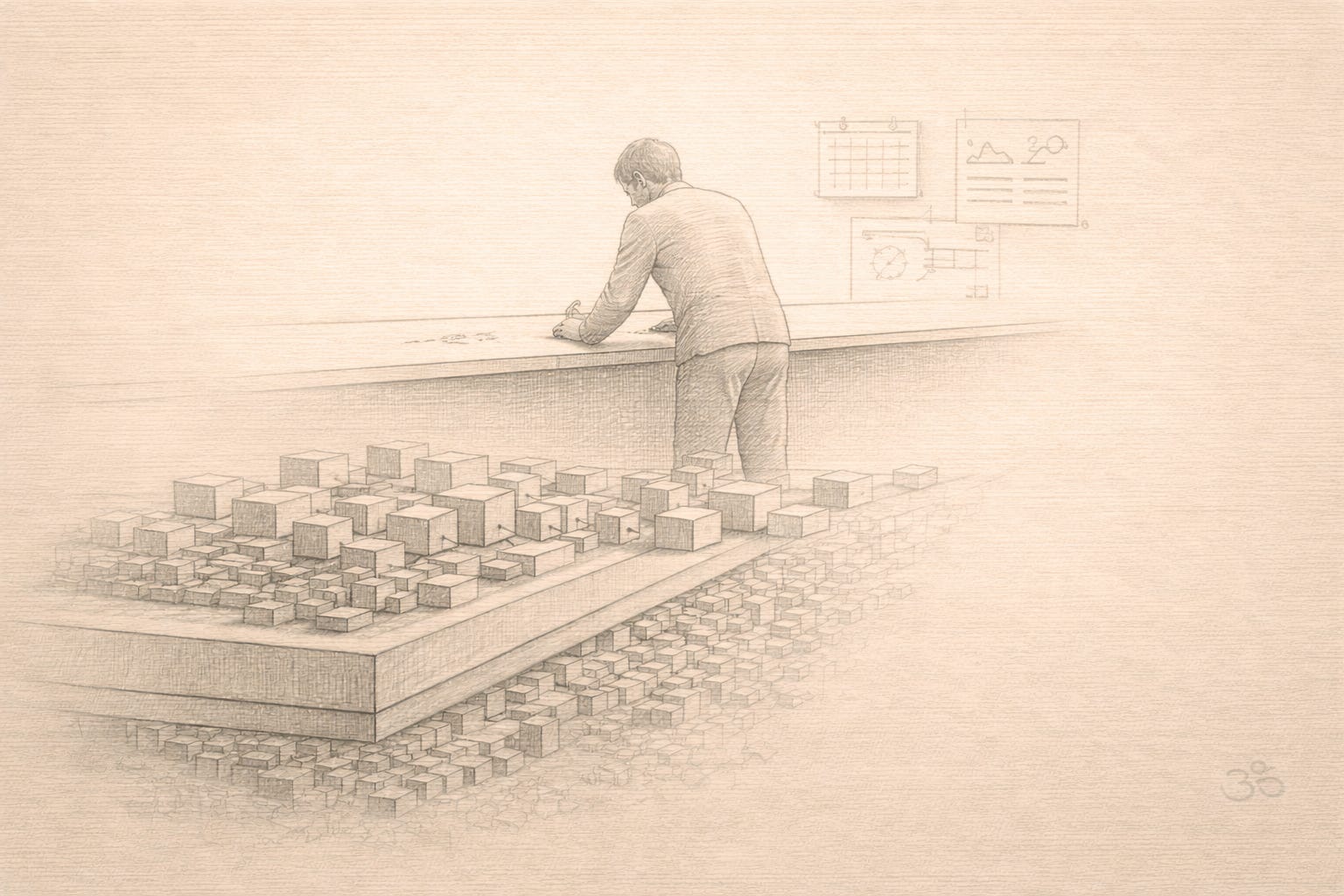
The system remembers what the organisation was never designed to hold.
If you found this useful, the likelihood is someone you know is asking the same question. Pass it on.