Element: Earth (Bhumi) - Hidden Foundations
Earth teaches us that the structures that matter most are usually below the surface.
The deepest stability is quiet, steady, and unseen.
The Architecture You Cannot Show on a Slide
There is a moment in almost every large programme when someone asks a familiar question.
“Can you show us what architecture has actually delivered?”
People look for the visible.
A new UI.
A new API.
A new workflow.
Something they can point to in a demo.
But architecture, when done well, does not always give you something to look at.
It gives you something to stand on.
I learned this during a major enterprise change that touched multiple domains and multiple business lines.
Teams were shifting, priorities were moving, and dependencies stretched across legacy systems and modern stacks.
For a while, progress felt slow and heavy.
Teams debated boundaries, data definitions, contracts, and ownership.
It felt like everything was moving and nothing was aligning.
Then something changed.
Confusion reduced.
Integration became easier.
The language between teams became clearer.
Design disagreements softened.
Nothing visible had been delivered.
But everything felt easier.
That was the moment I realised we were standing on something new.
An invisible blueprint had formed beneath the system.
The Power of What No One Sees
Software teaches this lesson long before leadership does.
The most critical systems are invisible to the user.
Networking protocols.
Security handshakes.
Contracts between services.
Data lineage.
Schema agreements.
These structures carry enormous weight, yet they rarely appear in a demo or a deck.
A powerful example is TCP.
A quiet, invisible agreement between machines that makes the internet work.
There is nothing to admire visually.
It simply works.
Its invisibility is the proof of its quality.
No drama. No spectacle. Only quiet reliability.
Architecture is similar.
Your real influence is not the diagram.
It is the shared language that teams begin to use without noticing.
It is the reduction of friction across domains.
It is the disappearance of confusion over time.
This is why Conway’s Law matters.
Systems reflect the structure of the teams that build them.
But the inverse is just as important.
When architecture creates clear domain boundaries and shared language, it silently shapes how teams communicate and collaborate.
Invisible alignment inside the organisation creates visible alignment in the system.
Invisible work is often the most valuable work.
It becomes the soil that carries everything else.
The Invisible Blueprint That Changed Everything
Teams were struggling with disputes, posting patterns, settlement flows, and reconciliation.
Nothing seemed broken, but everything seemed harder than it should have been.
The real issue was simple.
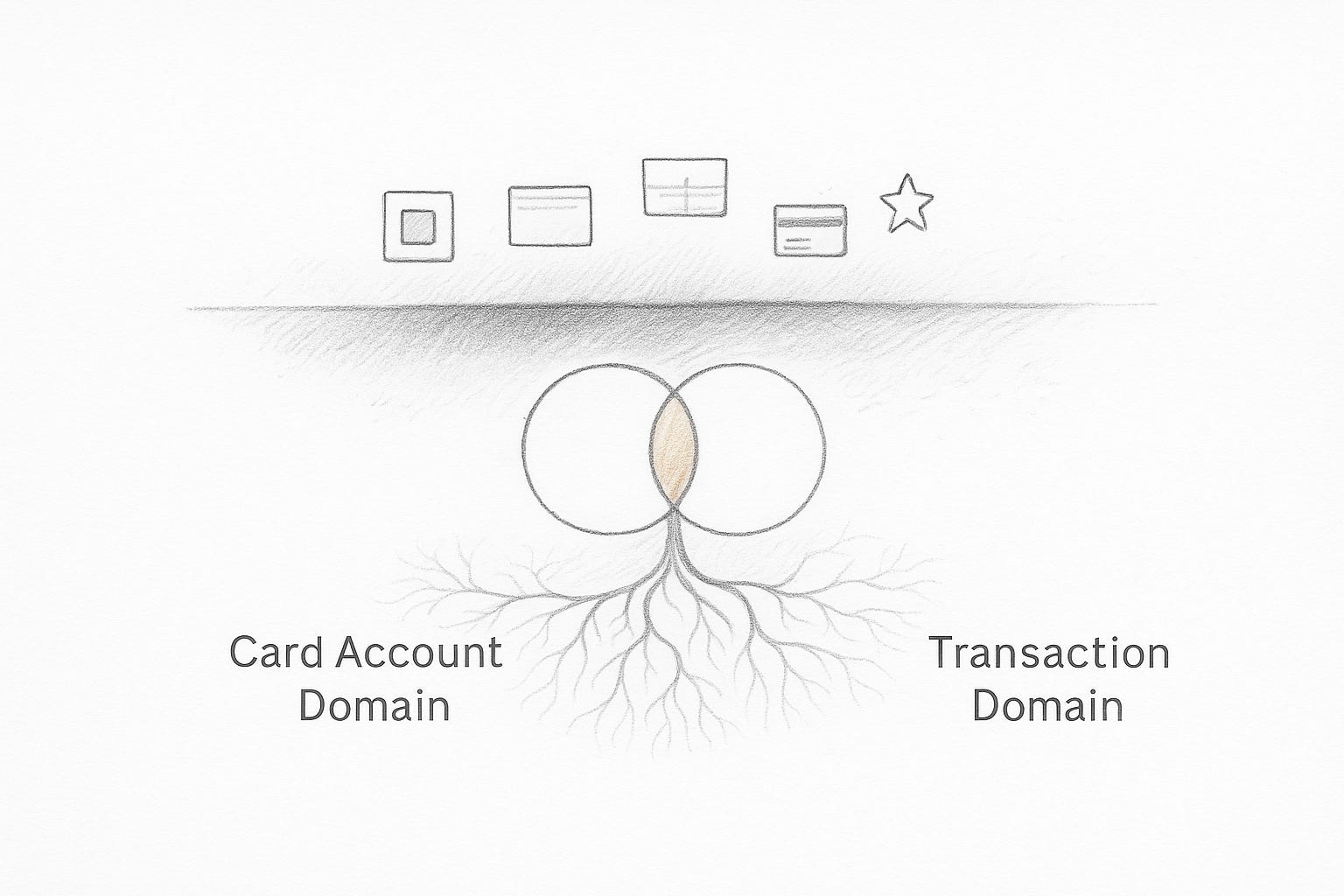
We had blended two domains that behave in completely different ways.
Card Account Domain
This contains slow changing, contractual, and regulated information.
Things like:
credit limit
billing cycle
interest structure
repayment rules
identity anchors
account status
risk profile
It requires stability, strong consistency, and clear ownership.
Transaction Domain
This contains the events of card usage in motion.
Things like:
Pending Transactions
holds
reversals
adjustments
settlement events
posting signals
merchant enrichment
This domain is high volume, event driven, asynchronous, and eventually consistent.
It is fast and fluid.
Once we separated these two domains correctly, the shift was immediate.
We did not build a single new feature.
Yet the system began to behave differently.
Integration challenges reduced
Disputes became easier to reason about
Posting flows stabilised
Reporting became more consistent
Data lineage stopped fighting itself
Teams used the same concepts naturally
Nothing dramatic happened.
But everything became easier.
That is what an invisible blueprint looks like.
It stabilises the entire system even when no one sees it.
Invisible Does Not Mean Accidental
Strong invisible foundations do not appear by chance.
They are created with clarity and discipline i.e. Intent.
1. Contracts Over Conversations
When boundaries are clear, teams stop negotiating their responsibilities in meetings.
Contract first design becomes the quiet architecture that creates flow.
2. Governance as Code
Rules in documents slow you down.
Rules in code guide you without asking for attention.
3. Naming as Architecture
The fastest way to measure architectural maturity is not the diagram.
It is the vocabulary.
Clear language removes the most expensive kind of complexity, human confusion.
4. Conway in Both Directions
Teams shape systems.
Systems shape teams.
Invisible alignment creates visible performance.
In your current system, where have you mixed fast and slow domains, and how much hidden complexity sits under that decision?
The Leadership Parallel
Invisible architecture mirrors invisible leadership.
Good leaders do not insert themselves into every decision.
They create clarity and walk away.
Their influence shows up in the absence of friction, not in the presence of control.
Architecture works the same way.
Its value is felt in what flows smoothly, not in what calls attention to itself.
The greatest compliment for a leader or an architect is the same.
“It just works.”
Sutra: Strength That Hides
The most valuable architectural work is rarely visible.
It shows up in alignment that does not need enforcement.
In the clarity that no one remembers struggling for.
In the stability that feels natural, not engineered.
“Strength hides in what supports, not what shines.”
Design the ground well.
Shape the roots with care.
Let the blueprint work quietly under the surface.

Reflect and Comment
Where in your architecture are invisible decisions carrying the most weight?
Share your reflection.
I read every thoughtful comment.
Subscribe to Systems and Sutras
If this essay resonated with your world, consider subscribing for weekly reflections that blend engineering clarity, architectural thinking, and timeless principles for leadership and life.
Subscribe to Systems and Sutras to receive each new essay every week.