

Element: Earth (Bhumi) – The shifting ground beneath every system
Earth represents stability, structure, and grounding. Yet even the firmest ground must learn to move.
Architecture, like Earth, must stay solid where trust is essential and flexible where discovery is required.
The Ground That Wouldn’t Stay Still
Early in my career, I believed architecture was about control.
We drew clean diagrams, detailed roadmaps, and governance decks designed to keep everything predictable.
Until one large-scale programme taught me otherwise.
It was a multi-year enterprise-wide change involving dozens of platforms, many engineers, and multiple deadlines. Every steering forum began with confidence. Every dependency was mapped, every integration point defined.
Then reality intervened.
Few months in, the landscape shifted. Priorities changed. Funding was reallocated. A policy pivoted mid-stream. A strategic vendor pivoted its roadmap.
Our architecture which is robust on paper; started to resist reality.
We had designed for certainty in a world that only guarantees change.
Those meetings turned into re-planning sessions.
Everyone was working hard, yet progress felt like swimming through clay.
The more we tried to control change, the faster it escaped.
That was the moment I began to understand something fundamental:
Architecture is not the art of freezing moving parts.
It’s the discipline of staying coherent when the ground moves.
System: Designing for Coherence, Not Control
Large programmes crave certainty.
Executives want predictable outcomes, traceable dependencies, and controlled variation.
But complex systems don’t behave like machines. They behave like ecosystems.
In ecosystems, control doesn’t scale, coherence does.
That’s why distributed architectures embrace eventual consistency over global locks and rigid synchronization.
Each component acts independently but converges over time.
They allow temporary divergence to achieve long-term harmony.
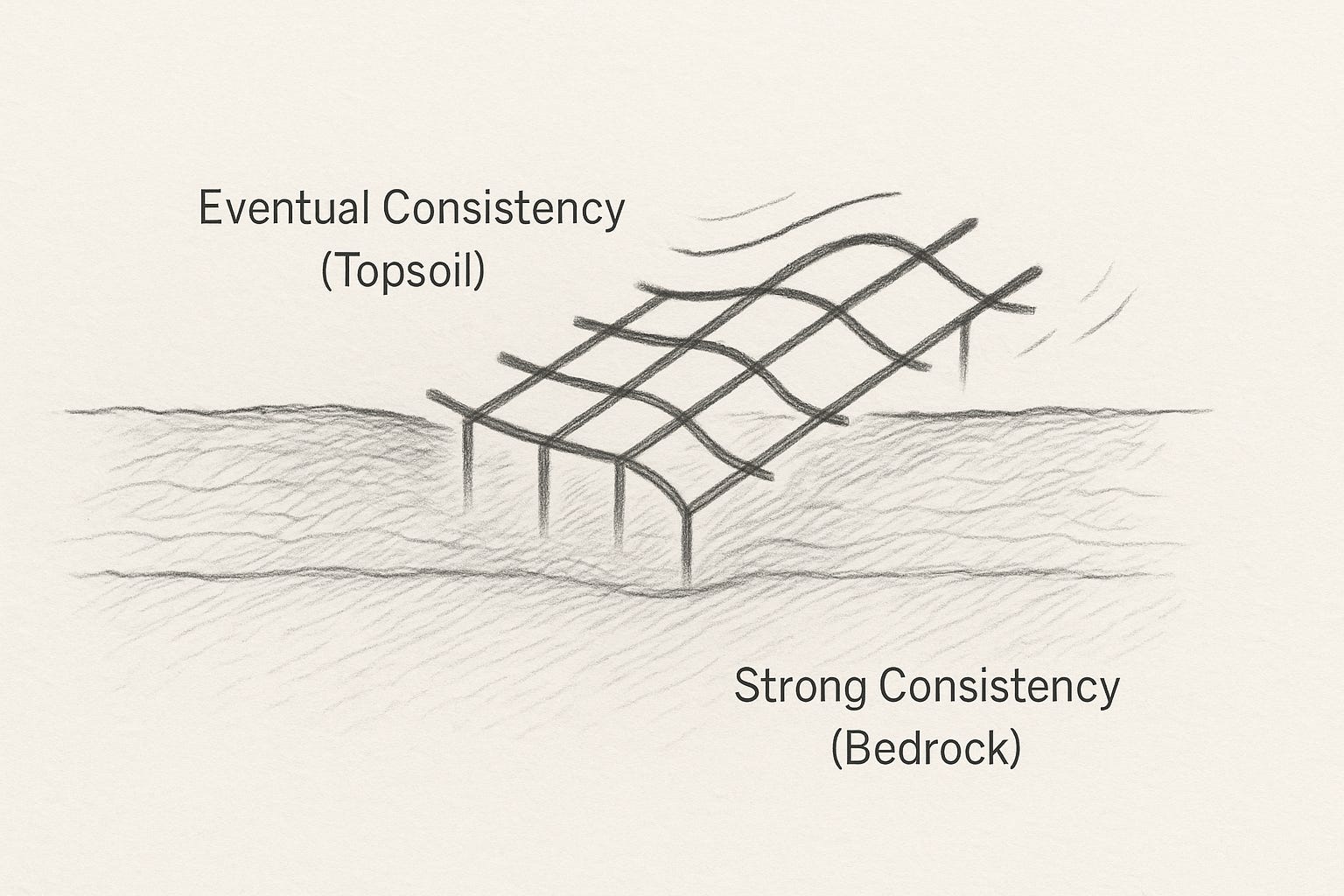
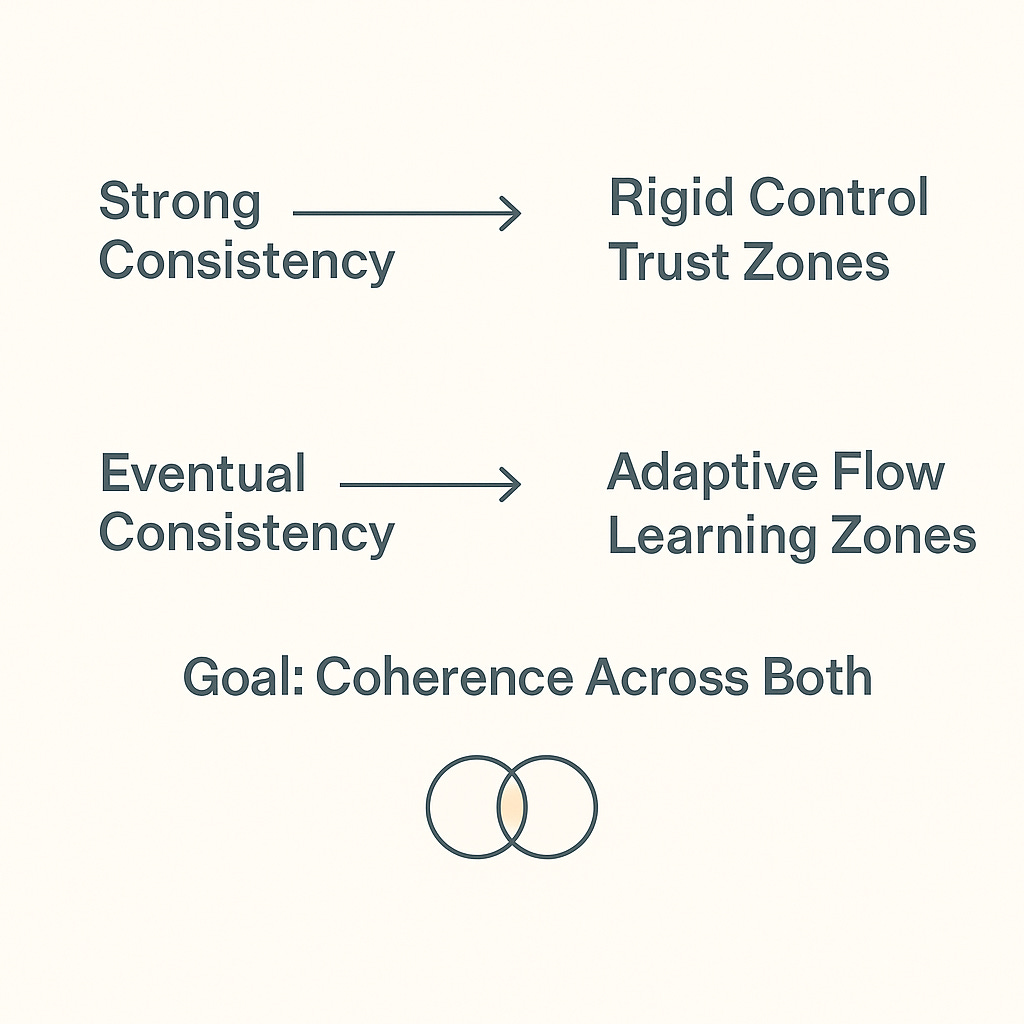
In architecture, this balance, between strong consistency and eventual consistency; defines whether a system can adapt or ossify
The Gradient of Consistency
Some domains must never drift:
Ledger balances in payments
Customer identity and KYC data
Regulatory submissions that must be atomic and auditable
These are the bedrock zones, the Earth that must not move.
Strong consistency here isn’t optional; it’s fiduciary and ethical.
Other domains, though, must move:
Analytics, notifications, data replication, workflow orchestration
Areas where learning and speed outweigh perfect alignment
Here, eventual consistency becomes oxygen; freedom to evolve and reconcile later.
Good architecture designs a gradient of consistency: firm where truth matters, fluid where learning matters.
Rigid where trust is absolute. Flexible where learning is essential.
Tools of Coherence
In practice, coherence emerges not through control boards but through clarity:
Architecture Decision Records (ADRs) i.e Key Design Decisions: Capture reasoning, trade-offs, not bureaucracy. Preserve intent across change.
Contract-first APIs: Express agreements in code, not in meetings.
Governance-as-code: Automate guardrails so policies evolve with context instead of slowing delivery.
These tools create a living soil, firm enough to hold shape, soft enough for roots to grow.
When architecture is treated as soil, not concrete, uncertainty stops being the enemy.
It becomes the natural environment where systems learn.
“Govern through soil, not concrete.”
Lessons from the Ground
In nature, stability doesn’t come from stillness.
Trees sway to stay upright.
Soil shifts to distribute pressure.
Roots move toward nourishment.
In large programmes, the same holds true.
The most resilient architectures don’t resist change — they absorb and redirect it.
Architecture isn’t governance theatre. It’s living geometry.
Systems that stay rigid fracture.
Systems that bend, endure.
Sutra: The Ground Does Not Move
Every architect begins by craving certainty.
With experience, you learn that stability doesn’t mean freezing the ground.
It means shaping systems that can stand when the ground shifts beneath them.
“The ground does not move. Our understanding of it does.”
True architecture is not about control, it’s about coherence.
Not rigidity, but rhythm.
Not stability through stillness, but through adaptation.
In every large programme, design like the Earth:
Firm where it must be.
Flexible where it can be.
That’s the real architecture of uncertainty.
You’ll receive weekly reflections connecting architecture, systems thinking, and timeless design principles
Subscribe now for essays that blend engineering precision with philosophical depth. The best architecture is never just technical; it’s philosophical.
Where in your architecture or your leadership; are you holding too tightly to certainty?
Where could coherence serve you better than control?
🪶 Share your reflections in the comments below.
I read and respond to every thoughtful note, this is how the Systems & Sutras community learns together.
Where in your architecture could coherence serve you better than control?