

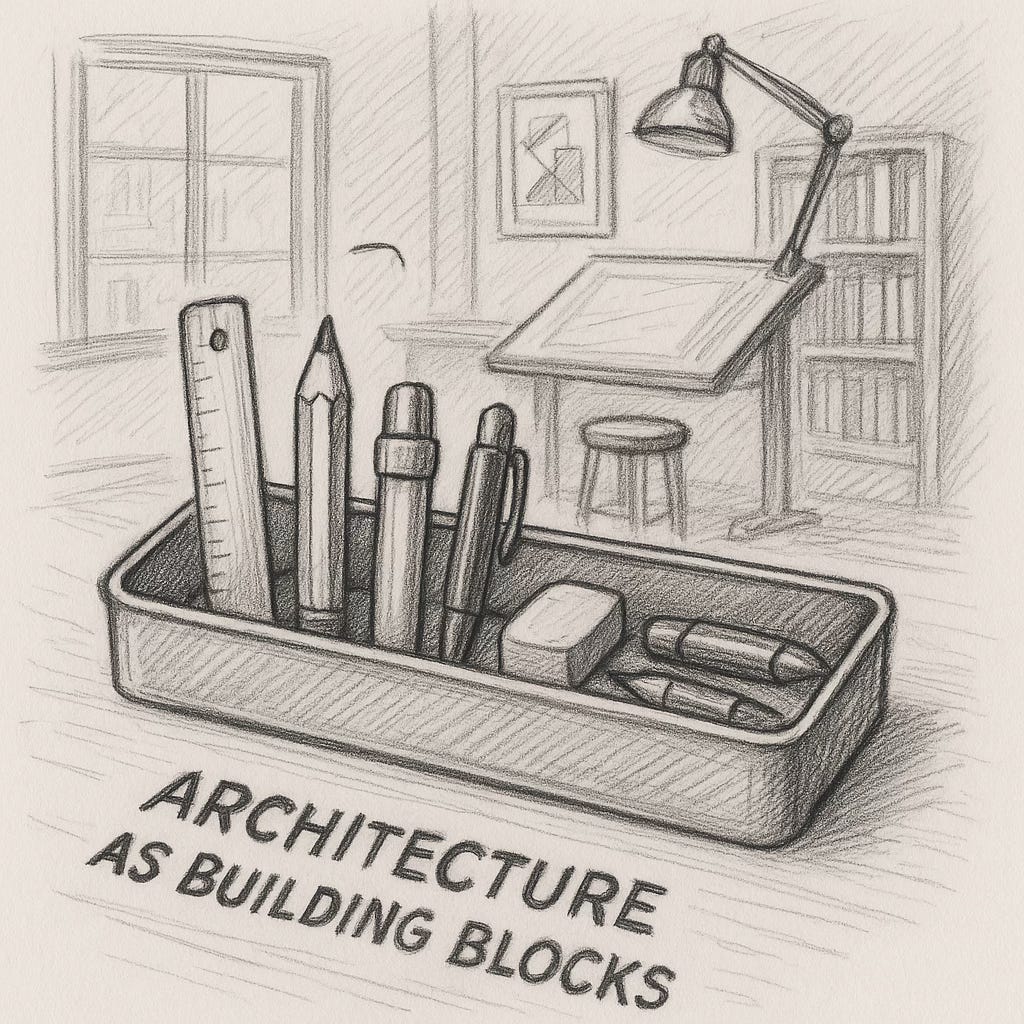
Every Architect Starts with a Pencil Box
If you think back to your school days, your first “architecture kit” was not digital or technical. It was a pencil box.
A small rectangle of order: a ruler for straight lines, a pencil for ideas, an eraser for second thoughts, a sharpener for precision, and a pen for commitment.
That little box held more than tools. It held a mindset: clarity, neatness, personal control.
You could draw, erase, adjust, and create something complete all by yourself.
And for a while, that is exactly how many architects still work.
Architecture, especially in its early stages, feels like a solitary craft: one person, one box, one vision.
But as systems, teams, and feedback loops grow, something starts to break.
Your neat pencil box becomes too small for the complexity of the real world.
You cannot draw everything yourself anymore.
You need a studio.
Why the Pencil Box Model Does Not Scale
The pencil box mindset works beautifully when things are simple, when control and completeness are possible.
But at scale, control becomes friction.

The pencil box is a metaphor for individual order: everything has its place.
Modern architecture requires systemic order: everything must find its flow.
The shift from box to studio is not about more tools. It is about more relationships between tools, people, and feedback.
From Tools to Flow: The Studio Mindset
A studio is the natural next step, a shared space where different minds and tools interact to create something living.
It is less about personal neatness, more about collective rhythm.
Here is how the metaphor evolves:

The pencil box represents control.
The studio represents collaboration.
Where the box values precision, the studio values progress.
Architecture as a Studio Practice
Architecture has matured from a solo act into an orchestration of many minds.
The modern architect is not the one with the steadiest hand, but the one who can guide others’ hands.
In a studio:
Tools are shared, not owned.
Mistakes are visible, not erased.
Guardrails exist as code, not policy PDFs.
Learning is continuous, not episodic.
The best studios are not perfect; they are adaptive.
They balance clarity with curiosity, structure with freedom.
They turn feedback into design fuel.
The Feedback Principle
Ben Franklin’s wisdom, “A place for everything, everything in its place,” celebrated stillness and order.
That worked when systems moved slowly.
But today’s architectures operate under different physics.
Feedback is constant, entropy is natural, and context changes weekly.
So, the new rule becomes:
“A place for everything until feedback teaches us better.”
Order is no longer the absence of motion.
It is stability through evolution.
Modern architecture leaders must create boundaries that flex and systems that learn, designing for change rather than against it.
From Craft to Culture
The real shift from pencil box to studio is not technical, it is cultural.
You cannot build adaptive systems with rigid mindsets.
That is why leadership in architecture now means:
Teaching principles and patterns.
Making feedback visible and safe.
Designing environments where good decisions can emerge naturally.
When teams understand
why boundaries exist,
where they have freedom, and
how feedback changes the design, the studio hums.
That is where real agility lives, not in process slides, but in shared learning.
My Reflection
Every architect starts with a pencil box.
It teaches clarity, discipline, and craft, the basics you will never outgrow.
But the real evolution comes when we put the box down and step into the studio.
That is where architecture grows from individual skill to collective intelligence.
“Great architects are not defined by their tools,
but by their ability to design spaces where others can build.”
Thanks Jeeban for the great article. Workspace is all about the tools and the place where your brain works well, you feel curious & productive and connected to things.